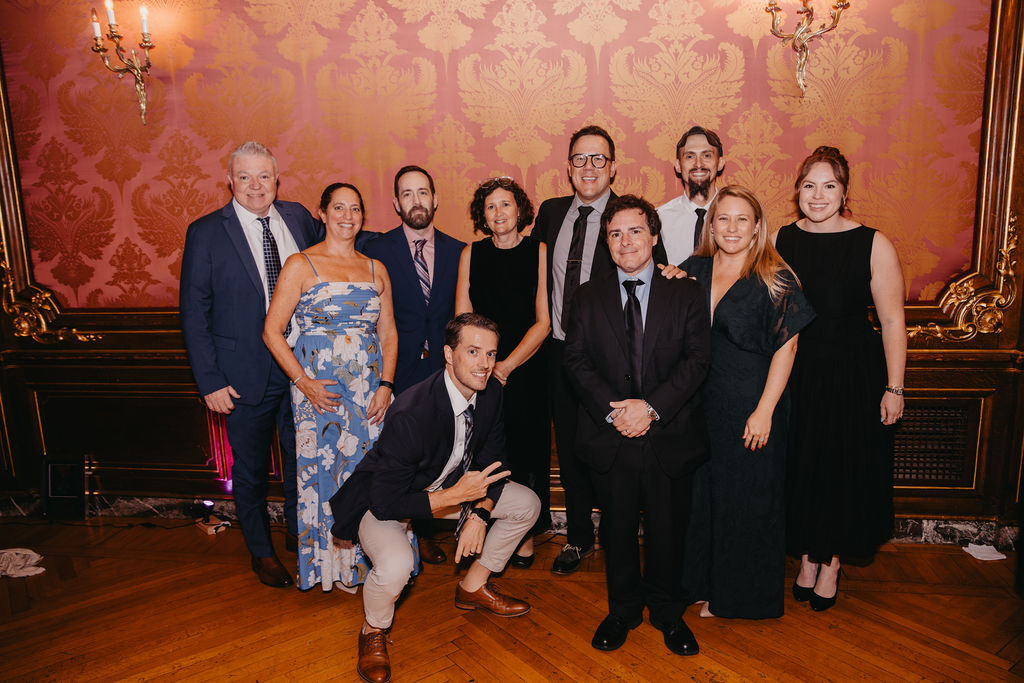
At AAF Baltimore’s 2026 Hall of Fame Gala, Todd Harvey—Mission’s own Co-Founder and Creative Director—received the AAF Silver Medal. One of the American Advertising Federation’s most respected individual honors, the Silver Medal recognizes a sustained career of creative leadership, mentorship, and service to the advertising community. Todd co-founded Mission more than 25 years ago, and in that time he’s helped build one of Baltimore’s most enduring, creative, and dependable independent agencies, while mentoring gobs of talent along the way.
Todd is generally opposed to any kind of self-promotion. It makes his skin crawl. BUT—this award is special and well worth celebrating. So, we made him sit down to answer questions about his (and really all of Mission’s) big win.
On its way to focusing squarely on brand marketing and advertising, Mission’s has been a number of things over the years—a gallery, event space, ticket broker, etc. If you think about the different “eras” of Mission, how do you think each of those versions of the company (and different versions of Todd) would react to seeing this award?
Is that a T. Swift reference? What I’ve always been attempting to curate is a place where thinking and making can happen, and inspired creativity can manifest itself. The core of what we are now was there from day one. The variations of that form have certainly evolved, as you pointed out—and those comings and goings are related to time and place: physical opportunities or constraints, cultural and economic shifts, and, most importantly, the influence of the people who’ve been in Mission’s orbit at any given time over the past 26+ years. In aggregate, that feels to me like what this honor is about.
For much of its history, Mission has seemed more focused on doing good work vs. the accolades that come with it; the classic “the work speaks for itself *SLASH* onto the next project” mindset. How has your perspective on awards changed over the years?
Yes, and much to my/our own detriment. For an industry that’s about attention and persuasion, we’ve never been deliberate or consistent with self-promotion. The work does speak for itself—whether in the form of insanely long-standing relationships, the gravity of uber–talented individuals, or the results we’ve been able to achieve for our clients. I’ve come to realize a perhaps obvious distinction, though: accolades are about the individuals who poured themselves into the work. All other recognition for Mission is secondary. We stand first as a unit behind the Mission moniker. Then, as a figurehead for the agency, I tend to be the recipient of the gratitude. The awards are a way for you (Matt), for instance, to get up on stage and rightfully accept the Best in Show award at the 2025 Addys. To represent the unit and be the figurehead in that moment.
What’s the most ambitious creative risk Mission’s taken that actually paid off? What do you remember about leading through that experience?
I don’t know what the “most” is, because creativity and the associated risks all deserve context. But I’ll say this: a big part of my job is encouraging the team to not focus on getting their thinking and creative output approved by the client. I want us to take risks, because that’s what has the best chances of cutting through. A big part of my job (and the client-facing team’s) is to lead our relationships in a manner that allows for belief in those risks so they’re not so… risky.
You’ve mentored a lot of people over the years. What’s a piece of mentorship or advice you received, maybe from an unexpected source, that’s stuck with you?
Simple. Jay McCutcheon was a Principal with Mission for many years prior to his retirement. He would always say to me, “Resist the temptation to be an asshole.” As a leader of an agency in an industry where ego, subjective convictions, and the fine art of persuasion are at its core, the temptation is unmerciful.
You called Baltimore’s creative community “talented, scrappy, generous, weird, and a little underestimated” and said that its underdog quality is part of why you love it. How has that identity shaped Mission’s work specifically?
It makes you work harder. And it gives you something beyond the work to believe in.
You spent a lot of your speech thanking peers, collaborators, and business partners rather than talking about yourself. What does it say about how you think about individual recognition in a business that’s been collaborative since day one?
Nothing—zilch, nada—including this agency, has been built, thought of, created, or honored because of only one person. It may feel like you came up with or did something on your own, but it’s the result of collective influence and context.
You also said Mission became “something much bigger than any one person.” Was there a particular moment or project or pitch that made that shift feel real to you?
As we’ve grown, one of the things that really makes me proud is when I hear about or see something that makes my jaw drop—and I didn’t know anything about it beforehand. I might get pulled into a final review, or even see something for the first time after a pitch. Those are the moments when it feels real.
Well, it’s been fun looking back. Big thanks to AAF Baltimore and every person who’s been along for the ride. Now, we’re back to work.
If you’re a brand looking for a creative way forward, we’ve got plenty left in the tank.
Let’s get to it!